Is it just me, or has the year seemed to have flown by for you, too? Christmas is just around the corner, so it is natural to start thinking about one of the most important aspects of the season – what are we going to eat?
This is the time when food is much more important than sustenance. This time of the year, more than any other time, food keeps traditions alive; those tastes and smells bring back memories of our childhood, and people we love.
For my family, Christmas was a huge affair, where our big, fat Italian family got together at my grandparents’ house every year. Aunts, Uncles, cousins, some we saw regularly throughout the year, and others we didn’t as much – but it was Christmas that was the glue that brought us all back. We played backyard cricket, laughed, gossiped, the men played cards, the women worked the kitchen, and we all ate far too much. There were always leftovers sent home, and we tried to get through it over the next few days, so nothing was wasted (sacrilege).
Since my grandparents passed, our Christmas ritual has changed. Like many families, everyone has grown up, had children of their own, moved away, some have lost loved ones, and many other changes have altered how we celebrate Christmas. We all, though, have all held on to traditions of old, and also developed new ways of celebration, new traditions. For me, that’s the Gingerbread House I make every year with my kids, now grown men (and we still do). I hope one day my boys will continue the tradition with their own children.
The food we prepare and eat at Christmas keeps memories alive. It connects us to the past and brings us together. We copy and remake recipes our grandmothers and mothers (and fathers and grandfathers) made, and make new ones to share too. They tend to be the special, indulgent sweet treats that we save for Christmas time; cakes, biscuits, and desserts that we don’t actually ‘need’, but create joy.
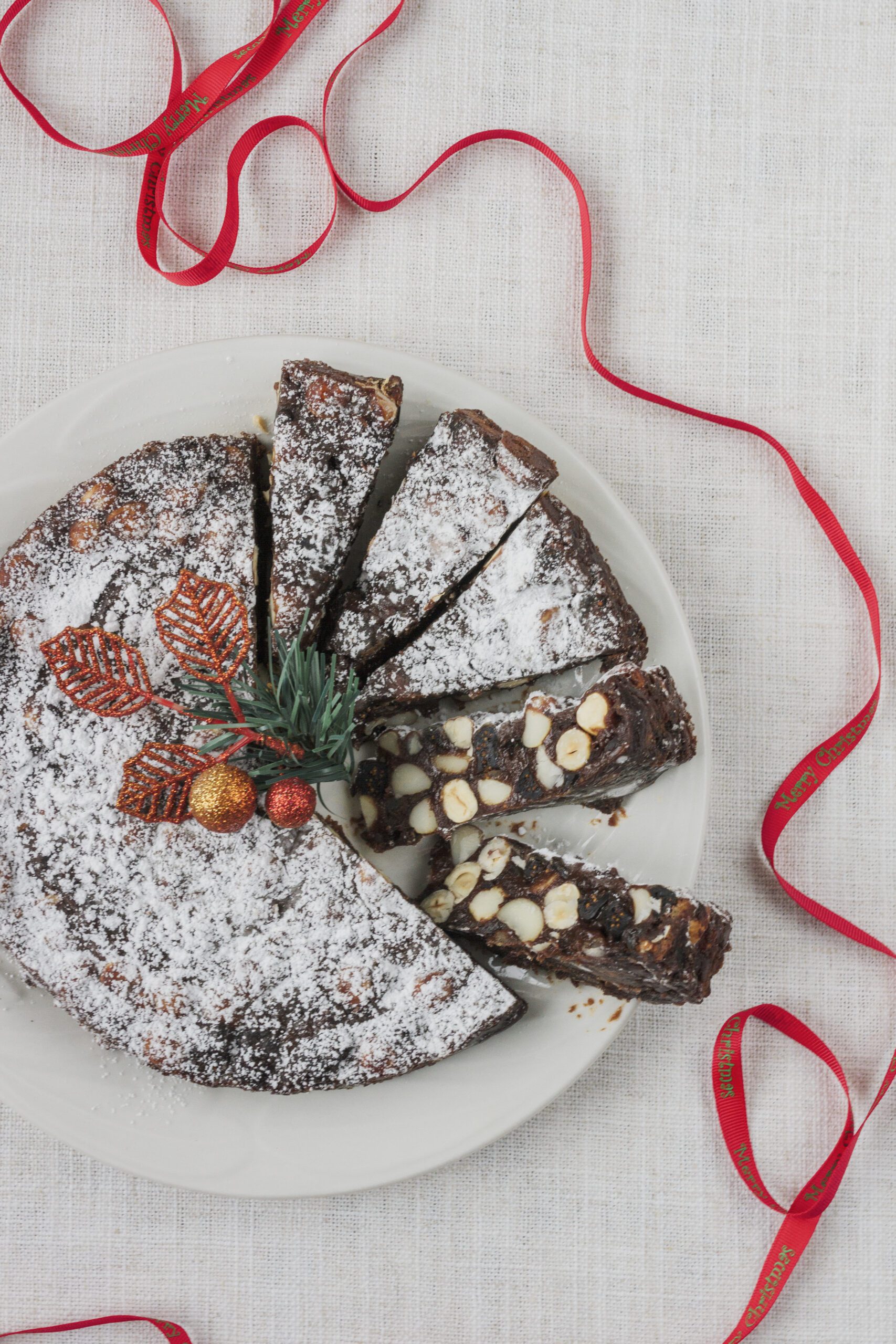
This recipe is for a traditional Christmas treat made by grandmothers for centuries in Italy. One of Italy’s most famous Christmas sweets, Panforte, originated from the Tuscan town of Siena in the 13th century. It literally translates to ‘strong bread’ – a description that suits its rich, bold flavours well.
Beginning as a simple creation of bread with pepper and honey that residents used to pay their taxes to the nuns who ran the monastery. Over the years, it has evolved into this indulgent sweet, spicy, dense cake, jam-packed with dried fruit, candied peel, nuts, and chocolate. It hardly uses any flour and is bound together with a toffee-like mixture made from honey and sugar, it has a chewy confectionery texture that is quite addictive. Traditionally served at Christmas, it is worth making all year round as it keeps well and actually improves with age. It makes a delicious gift, too.
I have used macadamia nuts in my recipe, as I love their soft, delicate flavor, but you can substitute them with the more traditional almonds if you like. A small slice is all you need. Enjoy with a cup of coffee, or as the Italians would do, a glass of Vin Santo.
Recipe from my book The Sweet Life – Home Baking and Sweet Treats Italian Style published by New Holland Publishers
Panforte
Ingredients
Method
- Grease a 20 cm round spring-form tin with a little softened butter and line the base with baking paper. Preheat your oven to 150°C.
- In a large bowl mix together the figs, prunes, nuts and peel. Sift over the flour, cocoa powder, spices and pepper and fold to combine
- Melt the chocolate either in 20 second bursts in a microwave, stirring in-between bursts, or in a bowl suspended over a saucepan of simmering water. Set aside.
- Place the sugar and honey into a medium saucepan and cook over low-medium heat, stirring until the sugar dissolves. Bring to the boil and simmer, without stirring, until the mixture reaches 116°C on a candy thermometer, or until a small amount immediately forms a ball when dropped into cold water.
- Pour the hot sugar mixture into the dry mix. Add the melted chocolate and mix everything together with a wooden spoon. Work quickly here as the mixture will harden as it cools, but be careful not to splash any of the melted sugar mixture on yourself as if you do it will burn.
- Spoon into your prepared tin and press the top with a spatula to compact and smooth the surface. If you let it sit for a couple of minutes to cool you can use damp hands to press to make it easier. Cook for 30–40 minutes, or until just firm. It will still seem wet in the middle. Press (carefully as it will be hot) with your finger. It should feel soft, but your finger will come away clean. Don’t over cook it as the panforte will harden as it cools and you still want it to be a nice chewy texture rather than like rock candy.
- Allow it to cool completely, then run a sharp knife around the edge to free it from the sides of the tin. Carefully unmould, keeping an eye out for any that is still clinging to the sides that may cause the panforte to break. Just pry it away with the knife as you unmould it. Remove the base and baking paper and dust liberally all over with icing sugar. If it’s still a little soft, refrigerate until firm. It’s ready to eat now, but the flavour improves the longer it sits. Wrap tightly in cling-film and store in the refrigerator for up to 6 months
Notes
Recipe from my book – The Sweet Life, Home Baking and Sweet Treats Italian Style, New Holland Publishers Photo – Locket Photography


Leave a Reply